Click the title to navigate to a PDF or folder of the resource.
Scroll down for additional information and a preview of the resource.
Medical – California’s name for Medicaid – has has seen tremendous changes in coverage over the last 30 years, from covering a select group of low-income families and people with disabilities in the 90s to by 2024, providing coverage to undocumented immigrants, the first state in the nation to do so.
This all changed with the Big Beautiful Bill, or HR1. HR1 introduced a series of changes that would effectively cause millions of Californians to lose their coverage. Changes include making formally eligible groups ineligible for Medical – including undocumented immigrants – and the introduction of monthly health premiums and work requirements.
Asian American immigrants and refugees have benefitted from expansion, and will be affected through H.R.1.
Please see below data we have collected from the Department of Health demonstrating Medical enrollment for Asian/American communities, disaggregated by ethnicity.
MEDI-CAL EXPANSION DATA



This data is being constantly updated to reflect the most recent trends. Last updated:
The Center for Asian Americans in Action thanks Jadyn Eve Lontoc for their assistance in organizing this ongoing database.
Enhanced Premium Tax Credits (ePTCs)
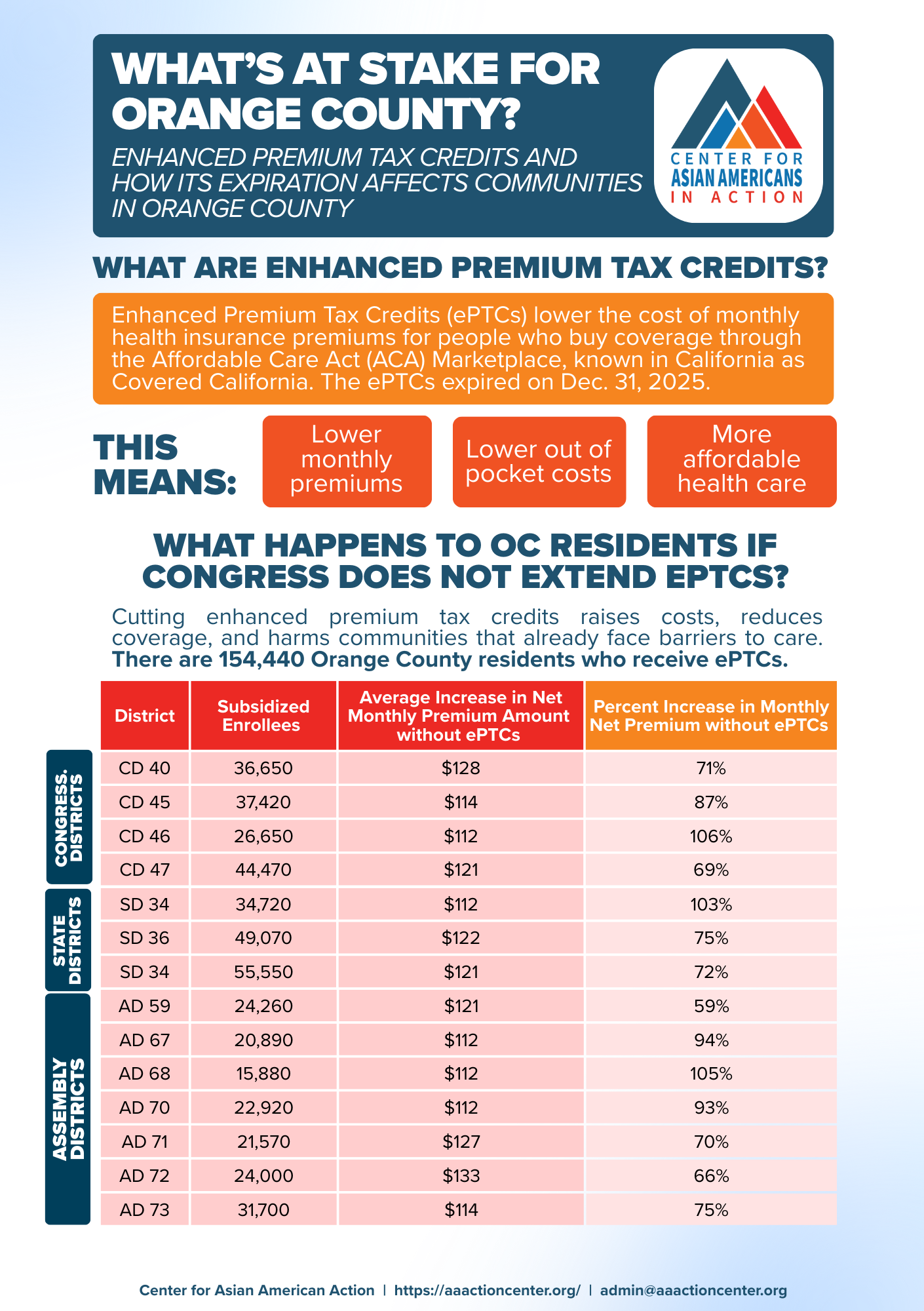
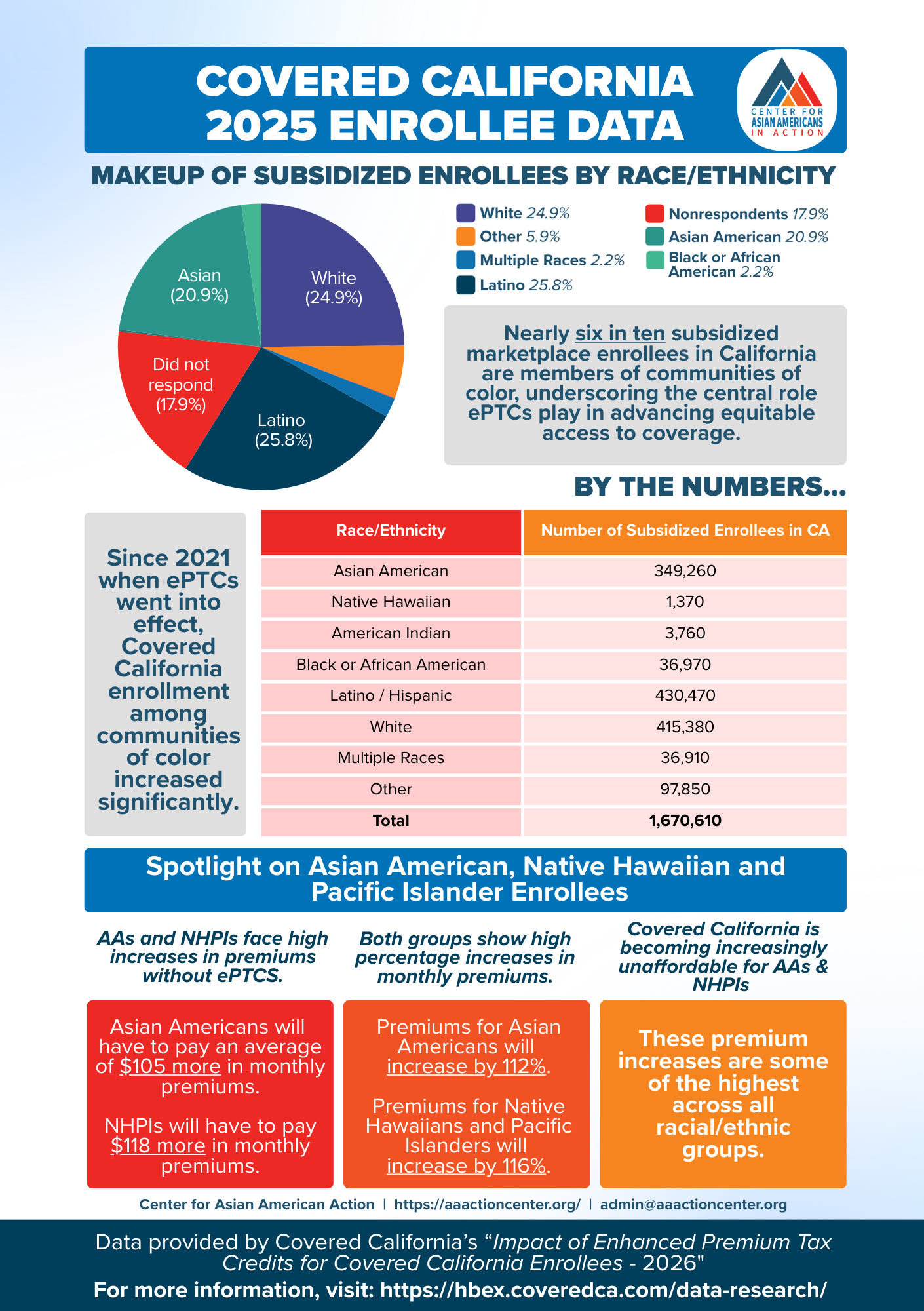
Enhanced Premium Tax Credits (ePTCs) lower the cost of insurance premiums for people who buy coverage through the Affordable Care Act (ACA) Marketplace, known in California as Covered California. The ePTCs expired on Dec. 31, 2025 and requires Congressional action to be reinstated.
Key Takeaways for Orange County
Marketplace subsidies are a major coverage lifeline across Orange County.
Every legislative district in Orange County shows substantial enrollment in subsidized marketplace coverage, underscoring the countywide dependence on federal premium tax credits to keep coverage affordable.
Certain districts have a significant number of residents who received enhanced premium tax credits.
Several Orange County districts, such as Congressional Districts 45 and 47, and State Senate Districts 36 and 37, each have more than 40,000 residents relying on subsidized marketplace coverage.
Large subsidy enrollment spans both coastal and inland communities.
Increased Covered California enrollment levels across districts like SD 37 and CD 47 in recent years demonstrates that enhanced premium tax credits benefits diverse communities across Orange County, from coastal cities to inland neighborhoods.
Assembly districts show strong local dependence
More than 160,000 residents across the seven Orange County Assembly districts rely on subsidized coverage, with AD 73 alone covering over 31,000 subsidized enrollees.
Center for Asian Americans in Action thanks Jadyn Eve Lontoc for their assistance in developing the factsheet.
Medical Expansion Data
Medical – California’s name for Medicaid – has has seen tremendous changes in coverage over the last 30 years, from covering a select group of low-income families and people with disabilities in the 90s to by 2024, providing coverage to undocumented immigrants, the first state in the nation to do so.
This all changed with the Big Beautiful Bill, or HR1. HR1 introduced a series of changes that would effectively cause millions of Californians to lose their coverage. Changes include making formally eligible groups ineligible for Medical – including undocumented immigrants – and the introduction of monthly health premiums and work requirements.
Asian American immigrants and refugees have benefitted from expansion, and will be affected through H.R.1.
Please see below data we have collected from the Department of Health demonstrating Medical enrollment for Asian/American communities, disaggregated by ethnicity.
This data is being constantly updated to reflect the most recent trends. Last updated:
The Center for Asian Americans in Action thanks Jadyn Eve Lontoc for their assistance in organizing this ongoing database.
kNOW yOUR rIGHTS: sTUDENTS AND fAMILIES
Everyone in the United States has certain rights under the Constitution, regardless of immigration status. Immigrant families should have a plan, know their rights, and be prepared in case of an immigration emergency.
dATA TO aCTION
A Data and Policy Brief About Asian Americans, Native Hawaiians, and Pacific Islanders in Orange County, CA.
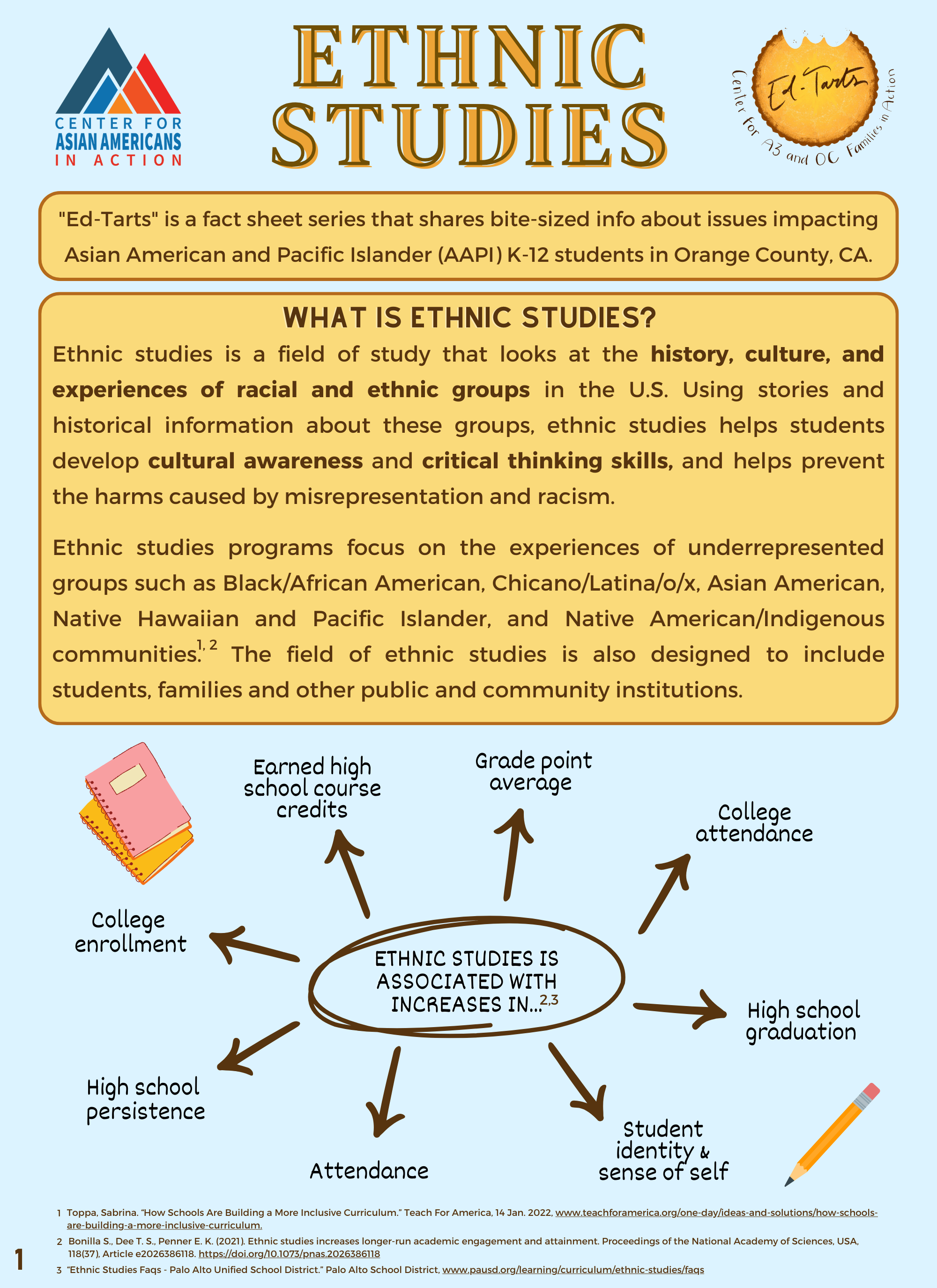
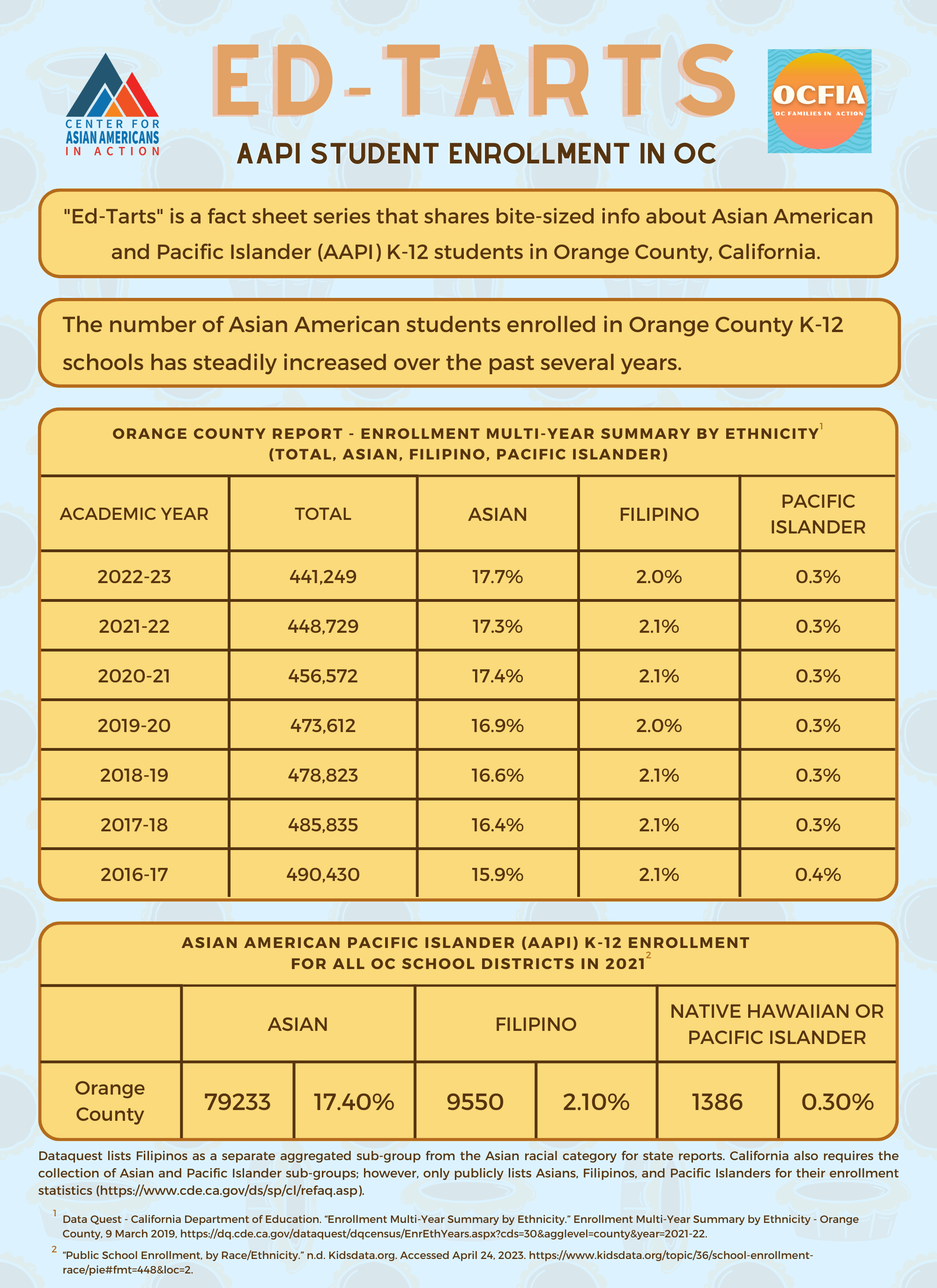
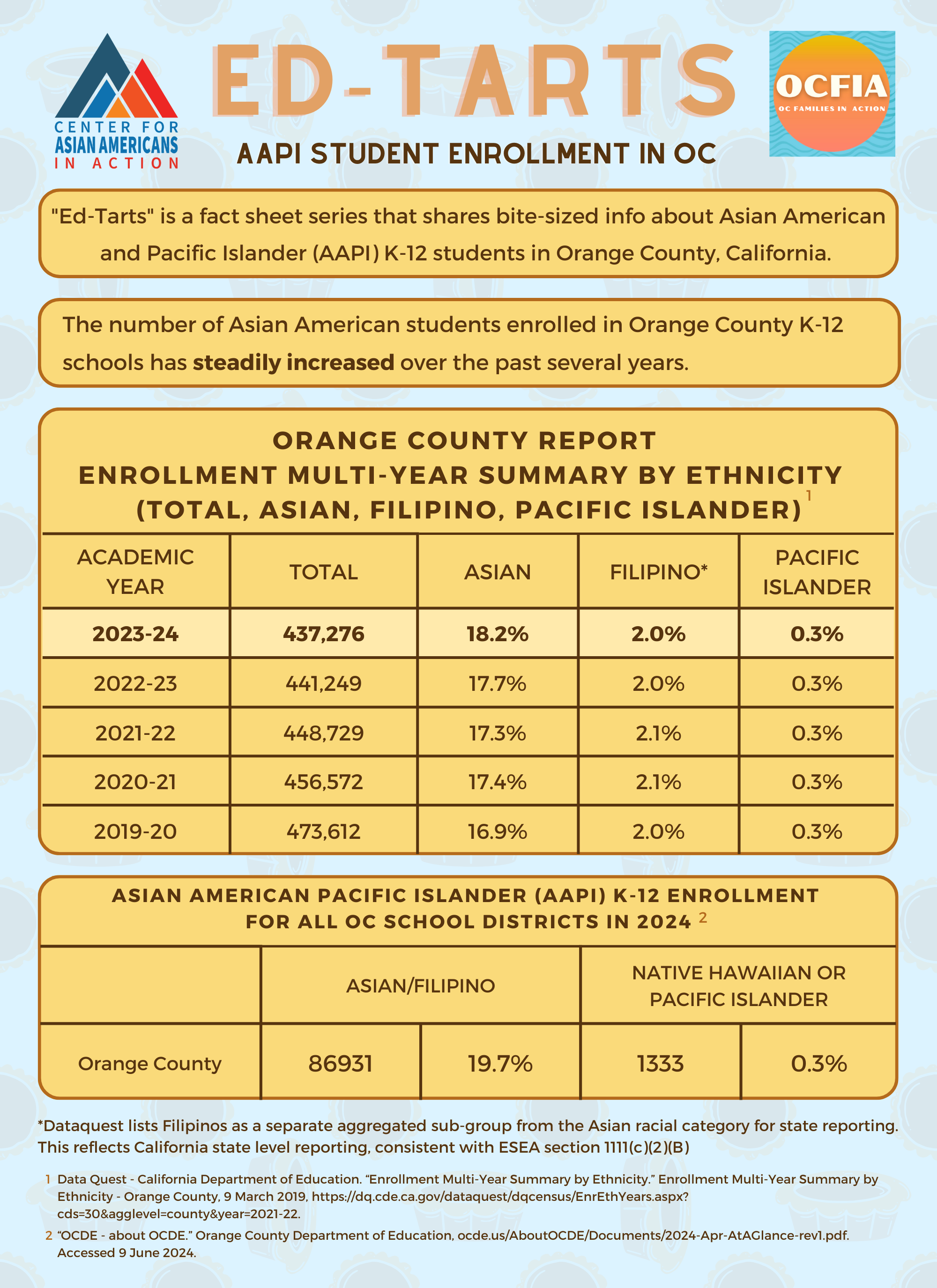
“Ed-Tarts” is a fact sheet series that shares bite-sized info about Asian American and Pacific Islander (AAPI) K-12 students in Orange County, California. Click the fact-sheet title for a full-resolution PDF download.
OC Families in Action is a project of the Center for A3.

Students experience identity-based bullying and harassment in schools and classrooms across the country. Check our our step-by-step guide to identifying, understanding and responding to these damaging behaviors. Translations in Chinese, Korean, and Vietnamese are available for download.
Together, let’s build a safe, secure, and welcoming campus environment for ALL students.
Created By: Lilli Gillen and Marissa Ruminson
Translated by Jessy Chen and Sherry Huang from OC Herald Center.
Translated by NamHyee Kim and Tammy Kim from Korean American Center.
Translated by Dung Hua and Becky Nguyen from Vital Access Care Foundation.
Medi-Cal Expansion Data
Sed ut perspiciatis unde omnis iste natus error sit voluptatem accusantium doloremque laudantium, totam rem aperiam, eaque ipsa quae ab illo inventore veritatis.